
OEM/ODM Jewelry Manufacturing: Sampling, Then Scale
A jewellery programme moves in two speeds. The slow part is the pilot, where one design is tooled, sampled over 25–30 days and approved. The fast part is everything after it, when mass production runs 3–4 weeks per batch and the marginal cost falls. The minimums are 100 units in artisan brass, 100 plus in stainless work and 50 in 925 silver, by design, with each design counted separately.

Key takeaways
- The pilot buys the tooling; the scale order only buys metal, bench time and shipping.
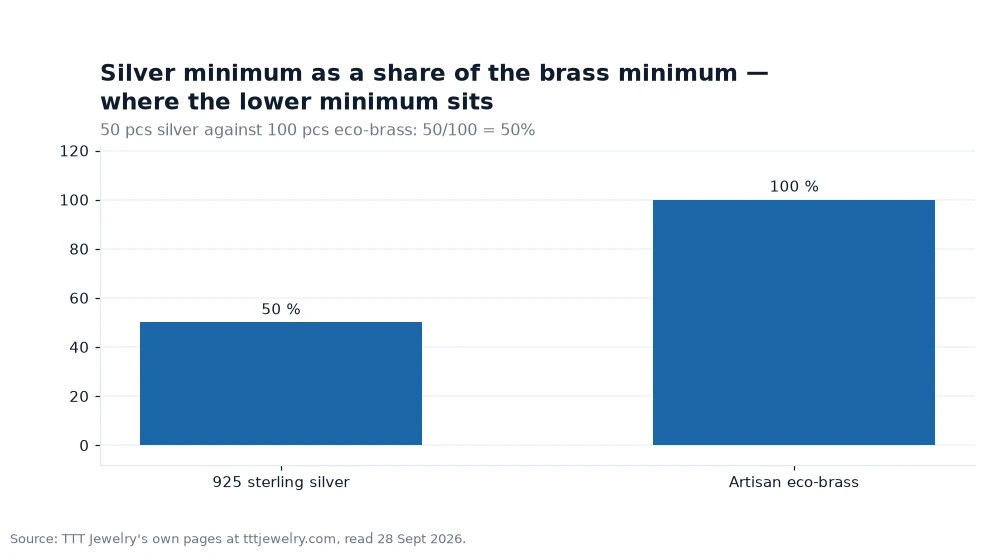
- A 50-piece silver minimum is half the brass minimum of 100 pieces, so the pilot is twice as cheap to enter in silver.
- Sampling is 25–30 days and production 3–4 weeks, so a first order runs roughly 7–9 weeks end to end.
- 100% inspection sits between production and delivery, and the mould stays yours under a 100% NDA.
Why the pilot costs more per piece than the run that follows
Every new design carries a fixed block of work. A mould has to be cut, a sample has to be cast, set, polished and plated, and someone has to sign off the finish before the batch is allowed to start. None of that scales with quantity.
So the pilot always looks expensive per piece, and the second order never does. Buyers who compare a 50-piece quote against a 500-piece quote and conclude the factory is penalising small orders are usually comparing a number that includes tooling with one that does not.
What the sampling window actually contains
The published 25–30 day window is not waiting time. It covers five operations in sequence: the 3D wax print first, then casting in a precision mould, stone-setting, bench polishing and electroplating to spec. Each has a failure mode that shows up later, which is why the window is quoted in weeks rather than days.
Approval matters more than the calendar here. A finish signed off on day 26 still leaves the production block untouched, whereas a finish queried on day 26 pushes everything behind it.
Scaling without changing the answer
Once a mould exists and a finish is approved, the production block is mostly a scheduling decision. The published figure is 3–4 weeks, and the range comes from batch volume and design complexity rather than from anything you can negotiate.
This is the point where a private label OEM jewelry manufacturer earns its keep: the second batch has to match the first, in the same finish, with the same hallmark, months later. Colour drift between batch one and batch four is the failure that a documented process prevents and a verbal promise does not.
| Stage | Published figure | What it buys you |
|---|---|---|
| 3D CAD model | under 48 hours | Dimensional approval before metal is cut |
| Master sampling | 25–30 days | One approved finish to scale from |
| Mass production | 3–4 weeks | Repeatable batches after approval |
| Inspection | 100% of pieces | A check between plating and packing |
| Design exclusivity | 100% NDA | Mould and CAD stay off the open market |
Choosing the material your pilot runs in
Silver is the lightest way to enter, which is exactly why the rest of this page treats 50 pieces as the pilot size. It casts cleanly, takes rhodium or 14K, 18K and 24K gold plating, and needs an anti-tarnish e-coating to stay bright on a shelf.
Brass doubles the entry quantity to 100 pieces but allows a lighter piece at a lower metal cost, and stainless steel starts at 100+ with PVD vacuum plating for pieces that have to survive daily wear. The right answer is usually dictated by the retail price band, not by the factory.
The ratio that decides how fast you can test
If a brand can only be wrong cheaply once, it should be wrong in silver at 50 pieces. That is half the commitment of a brass pilot at 100 pieces, which is the whole argument for prototyping a new silhouette in the lower minimum before committing the design to a plated line.
The same logic works in reverse for categories that sell in volume and at lower prices, where the brass route's extra 50 pieces are absorbed by a larger first order anyway.
What changes between the pilot and the fourth batch
Nothing should, which is the whole purpose of the pilot. The mould is cut once, the plating specification is agreed once, and the hallmark is struck to the same standard on every run. A documented process under ISO 9001:2015 is what makes the fourth batch measurable against the first.
The failures that show up months later are usually drift: a plate that is a shade warmer than the approved master, or a stone set a fraction lower. Both are caught inside the 100% inspection stage rather than by the buyer, provided the reference sample still exists and is still sealed.
Setting a reorder trigger from the published windows
The two numbers that decide when to reorder are the published 3–4 week production block and the shipping time to your warehouse. Once a design is tooled, that is the full factory lead time, because the mould, the CAD file and the plating specification already exist.
So the reorder point is a stock calculation with a fixed factory term. Add your own approval days, then set the trigger high enough that sell-through during the lead time does not leave a gap on the shelf.
Worked example: sampling days spread across pilot and scale
Take the two published minimums and the sampling window and hold them up against each other. The silver minimum is 50 pieces and the brass minimum is 100. Expressed as a share, 50 ÷ 100 = 0.5, so the silver pilot is 50% of the brass commitment.
Now do the same with time. A 25-day sample spread over a 50-piece pilot is 25 ÷ 50 = 0.5 days of sampling per piece. At the 30-day end it is 30 ÷ 50 = 0.6 days. Over a 100-piece brass pilot the same window divides as 25 ÷ 100 = 0.25 and 30 ÷ 100 = 0.3 days per piece.
The time does not shrink; the denominator grows. That is why the second order always looks cheaper per unit than the first, and why a design worth testing is worth testing at the smallest published quantity.
Frequently asked questions
Should a first order be a pilot or a full run?
Pilot first. Sampling takes 25–30 days and produces the approved finish; only after that does the 3–4 week production block start, and the pilot is where a wrong guess costs least.
Why is the silver minimum lower than the brass minimum?
Published minimums are 50 pieces per design for 925 sterling silver against 100 for artisan eco-brass, because silver casts and finishes with less setup than a plated brass line.
How do you keep a second batch matching the first?
Use the documented process: the same mould, the same plating specification, the same hallmark and a 100% inspection pass before packing, all covered by ISO 9001:2015 documentation.
Planning the second order before the first arrives
The pilot exists to de-risk the scale order, so the time to ask about repeatability is before tooling starts. Ask which finish was signed off, which hallmark goes on the piece and what the inspection step checks. The sterling silver line shows how the 50-piece route is built, and the factory page lists the eight stages each batch passes through.
Every number in this piece — the confidentiality terms and the laser engraving stage plus the master-sample benchmark — originates at the manufacturer's own website on the tttjewelry.com site, from my own reading on 28 Sept 2026. Nothing else here is inferred. The chart's relative scale is my own — the site supplies the inputs only[1].